
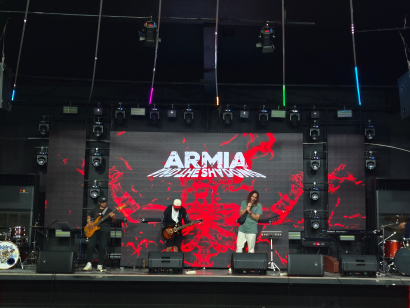
For more than three decades, Lutfi Armia has been closely tied to heavy distortion through Purgatory.
Now, he steps into a new phase. He does not leave that identity behind. Instead, he expands it through his solo project, Armia and the Shadows.
This transition does not come from a sudden ambition. It grows from a deeper need.
During Purgatory’s hiatus, Lutfi faced something he could not ignore: his creative drive kept moving.
He explained that music has always been part of how he lives. When the band paused, that energy still needed an outlet.
As a result, Armia and the Shadows emerged not as a filler, but as a phase that had to happen.
Through this project, Lutfi creates a space for exploration that had long been delayed.
Here, he begins to redefine himself. He no longer stands only as a guitarist.
Lutfi also becomes a storyteller, shaping ideas in a more cinematic and expressive form.
He sees this step not as a shift in direction, but as an expansion of identity.
What he built with Purgatory remains the foundation, yet it now grows into something freer and more layered.
From Music to Narrative: “Hidup Setara”
This evolution begins to take shape in a more tangible way.
It finds its momentum when Armia and the Shadows steps in to work on the original soundtrack for OZORA: Penganiayaan Brutal Penguasa Jaksel.
From there, the project reaches a wider stage.
The film itself connects with a global audience through Netflix, allowing the music to travel just as far.
Through the single Hidup Setara, Lutfi collaborates with Doni Akbar to translate the film’s emotions into sound.
The process begins from a personal connection to the issues portrayed.
Lutfi shares that he followed the real-life context behind the story closely.
Feelings of anger, disappointment, and sadness became the core energy behind the composition.
With direct access to the film’s script, the approach becomes more immersive.
The music blends social reality with emotional interpretation.
In the end, Hidup Setara stands not just as a soundtrack, but as a voice that reflects pain and resistance.
Read more: Echoes, We Hide Release Debut EP Under Firefly Records
A More Personal Chapter from Lutfi Armia
Compared to his previous work, this project takes Lutfi into a far more personal space.
For the first time, he steps in as both vocalist and lyricist. Every word comes from lived experience.
He admits that the emotional weight even forced him to pause during recording sessions because it felt too intense to continue.
This depth gives the song a different impact. It becomes more than a composition.
It turns into a lived experience, both for its creator and its listeners.
Collaboration That Expands the Vision
The project grows further through collaborations with Anggy Umbara and Sara Wijayanto.
Their involvement helps align music and visual storytelling into one cohesive direction.
At the same time, Sara adds an emotional and spiritual layer that deepens the meaning behind the track.
Lutfi views this moment as a major milestone. He sees how music can move beyond standing alone and become part of a larger narrative.
During the process, he also faced new challenges.
For the first time, he explored rap within a track, pushing past boundaries he had never crossed before.
From “Ruang Semu” to a Cinematic Path
This direction actually began earlier with Ruang Semu (My Drowning Soul), which became part of the soundtrack for the film Gundik.
Together, these works show that Armia and the Shadows is not just an experiment.
It marks a clear path forward, one that blends music, emotion, and visuals into a unified narrative.
Lutfi Armia: A New Identity, Rooted in the Past
For Lutfi, this project is not about leaving the past behind. It is about opening new possibilities from the identity he has built.
He now aims to share more than sound. He wants to express emotion, uncertainty, hope, and life experiences in a more honest and cinematic way.
Starting with OZORA, Armia and the Shadows moves into its next phase.
The project continues to position music as a cross-disciplinary medium, capable of living across film and beyond.
Looking ahead, Lutfi envisions it as a home for cinematic works across different formats. For him, this is only the beginning.

A bunch of electronic dance music lovers who wants to share news from Indonesia to the world.