
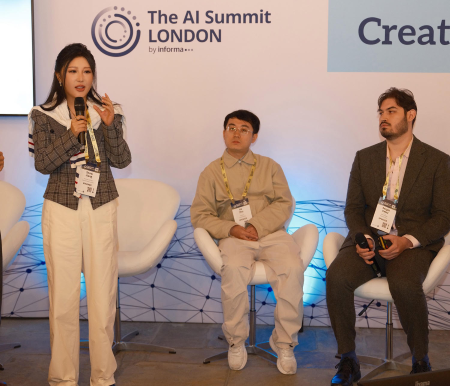
Following its appearance at the AI Summit London, Cheerful Music has shared more details about its AI music strategy.
The company explained how it develops AI-powered music while protecting artists’ rights.
It also emphasized that human creativity remains at the center of its creative process.
During the Q&A session, founder and CEO Snow Jiang answered questions from the audience.
She discussed topics including copyright, AI-assisted production, and marketing strategy.
She also explained Cheerful Music’s approach to voice licensing and its long-term business model.
Her answers reinforced a consistent message: AI should support creativity, not replace it.
Cheerful Music Prioritizes Human Creativity
One of the biggest questions surrounding AI-generated music is copyright ownership.
According to Snow Jiang, fully AI-generated music still faces considerable legal uncertainty in many markets.
Because of that, Cheerful Music has deliberately avoided a one-click AI music model.
Instead, every song released by the label begins with human songwriters.
AI is introduced later in the production process to improve efficiency while ensuring genuine creative expression remains at the heart of every release.
Cheerful Music Uses AI as a Creative Assistant
Snow Jiang explained that AI plays a supporting role rather than acting as the primary creator.
She pointed to producer He Zhu as an example of this workflow.
He uses AI to streamline parts of the production process while keeping creative decisions in human hands.
The company’s virtual artist Lynn (灵玥) also reflects this philosophy.
Cheerful Music first builds Lynn’s vocal identity by training AI with multiple licensed human voices.
After that, AI helps generate complete vocal recordings more efficiently.
Snow Jiang emphasized that every voice used for training has been legally licensed by its original artist.
Social Media Comes Before Streaming
Cheerful Music also revealed a different promotional strategy for its virtual artists.
Rather than focusing first on streaming platforms, the company prioritizes short-form video and social media.
Snow Jiang believes these platforms create stronger emotional connections between virtual characters and real audiences.
That strategy has already supported the growth of virtual artists including Lynn (灵玥) and PeanutsJack (花生杰克).
Read more: Cheerful Music Explores AI and Human Creativity at AI Summit
Licensing Framework Protects Artists
Questions about AI voice rights have become increasingly important across the music industry.
Snow Jiang said Cheerful Music follows a transparent licensing framework for every participating artist.
Each contributor signs a paid licensing agreement that clearly defines how their voice can be used.
These agreements are structured as partnerships instead of permanent buyouts, allowing artists to retain important rights over their voices.
Multiple Revenue Streams Support the Business
Cheerful Music also outlined how its AI music business generates revenue.
Income comes from traditional streaming services such as Spotify, Apple Music, and major Chinese music platforms.
The company also earns revenue through sync licensing.
Its music is licensed for television, advertising campaigns, retail environments, and other commercial applications.
Snow Jiang noted that music rights management becomes valuable anywhere music is played publicly.
AI Should Never Replace Originality
The discussion concluded with the role of AI in maintaining artistic originality.
Snow Jiang acknowledged that today’s major streaming platforms have become increasingly effective at identifying AI-generated content.
Low-quality automated productions are now easier to detect and label.
She also recognized that rapid AI development has created new challenges for traditional artists.
For that reason, Cheerful Music has established a clear internal policy.
The company will never use artists’ work for commercial AI training without their explicit permission.
According to Snow Jiang, data and algorithms can help improve efficiency and audience insights.
However, they should never come at the expense of artistic originality or creators’ rights.

A bunch of electronic dance music lovers who wants to share news from Indonesia to the world.